The Intelligence Imperative: Navigating the AI-Driven Corporate Landscape
Balancing Aggressive Innovation, Cross-Functional Synergies, and Robust Governance Across the Modern Enterprise
Executive Summary
We have crossed the Rubicon of the digital age. Artificial Intelligence (AI)—spearheaded by rapid advancements in Generative AI and advanced machine learning—has transitioned from a peripheral innovation to a core macroeconomic driver. For the modern enterprise, AI is no longer merely a tool for operational efficiency; it is a fundamental restructuring of how value is created, delivered, and captured.
This briefing outlines the dual-edged nature of the AI revolution. While early adopters stand to unlock unprecedented synergies, hyper-personalized customer experiences, and augmented decision-making, they must simultaneously navigate a complex matrix of data privacy risks, algorithmic biases, and immense change-management hurdles. The mandate for C-suite leaders is clear: move beyond siloed pilot programs and embed AI into the organizational DNA, balancing aggressive innovation with robust governance.
1. The Value Horizon: Synergies and Strategic Benefits
The integration of AI across enterprise functions is driving a paradigm shift in corporate agility and capability. We categorize these benefits into three primary value streams:
A. Operational Velocity and Cost Optimization
AI excels at ingesting massive datasets to automate routine, high-volume tasks. By streamlining workflows in finance, HR, and IT operations, organizations are witnessing up to a 30-40% reduction in processing times. This is not about headcount reduction, but workforce augmentation—reallocating human capital to high-order, strategic problem-solving.
B. Cross-Functional Synergies
AI acts as a connective tissue across historically siloed departments. Consider the synergy between Supply Chain and Marketing: predictive AI models can now anticipate localized consumer demand spikes based on social sentiment and instantly trigger automated procurement and logistics realignments.
C. Augmented Decision-Making
Through advanced predictive and prescriptive analytics, leadership teams are moving from reactive management to proactive strategy. AI models simulate millions of business scenarios in seconds, optimizing pricing strategies, M&A target identification, and capital allocation.
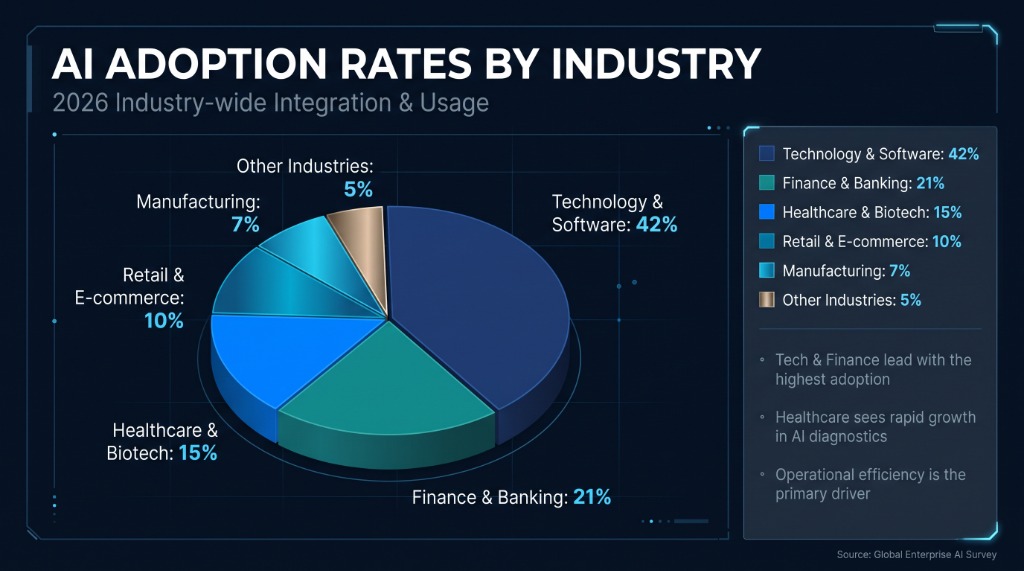
Infographic: Projected AI Value Distribution & Adoption Across Enterprise Sectors
(The following chart illustrates where organizations are capturing the most immediate integration and ROI from AI deployments)
2. Industry Voices: The View from the Boardroom
To contextualize this shift, we look to the vanguard of industry transformation. The sentiment among global leaders reflects a blend of fierce urgency and calculated caution.
"AI will not replace the modern CEO. However, the CEO who actively leverages AI to synthesize market dynamics will rapidly outmaneuver the one who relies solely on legacy intuition."
— Managing Director, Global Investment Bank
"Our supply chain was a reactive entity. By integrating machine learning models, it has become a proactive, predictive organism that anticipates disruptions before they materialize on the balance sheet."
— Chief Operating Officer, Fortune 100 Logistics Firm
3. The Risk Matrix: Challenges and Corporate Liabilities
The scale of AI's potential is matched only by the severity of its risks. Deploying AI without a robust governance framework exposes the corporation to systemic vulnerabilities.
A. The "Black Box" and Hallucination Risks
Deep learning models often operate as "black boxes," making it difficult to audit how a specific conclusion was reached. In regulated industries (e.g., healthcare, financial services), relying on an unexplainable AI decision or acting on an AI "hallucination" (plausible but entirely false outputs) can lead to severe compliance breaches and reputational damage.
B. Data Privacy and IP Leakage
Generative AI models require massive amounts of data. Without secure, enterprise-ringfenced infrastructure, employees utilizing public AI tools risk exposing proprietary source code, M&A strategies, and sensitive customer data to the public domain.
C. Workforce Displacement and Change Management
The cultural resistance to AI is profound. Employees fear obsolescence. The true challenge for the C-suite is not technological integration, but change management—upskilling the workforce and fostering a culture of symbiotic human-machine collaboration.
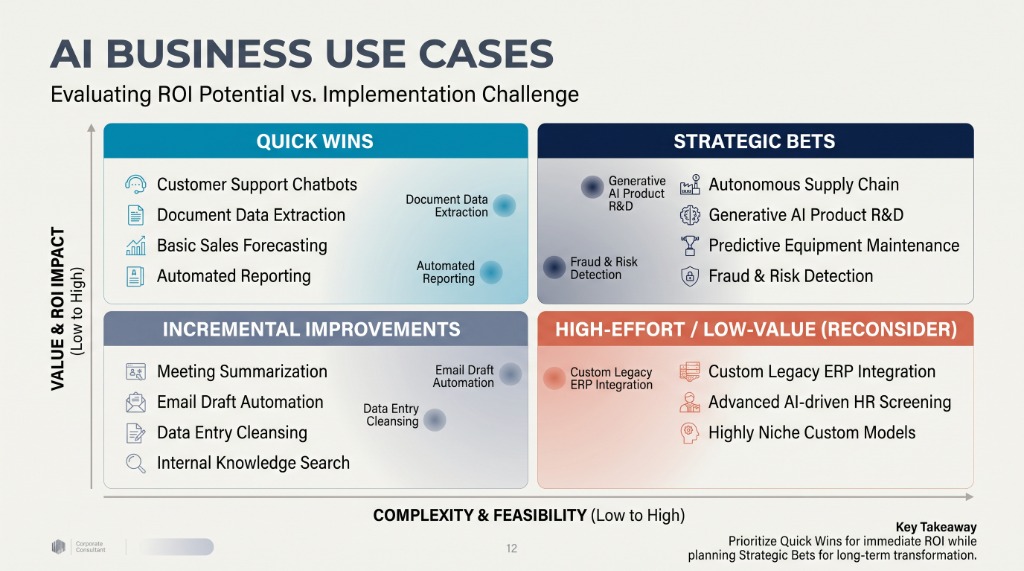
Graph: The AI Strategic Prioritization Matrix
(Organizations must plot their AI initiatives based on potential ROI impact versus implementation complexity and risk)
4. The Path Forward: A Strategic Blueprint
To transition from passive observation to active value generation, organizations must adopt a disciplined, top-down AI agenda:
- Establish an AI Center of Excellence (CoE): Centralize AI governance to standardize tools, manage vendor ecosystems, and enforce data security protocols.
- Define the "Human-in-the-Loop" Mandate: Mandate that high-stakes AI outputs are verified by domain experts. AI should inform the decision, not make the final call in critical business junctions.
- Invest in Data Architecture: AI is only as intelligent as the data it consumes. Modernizing legacy data lakes and ensuring high data fidelity is a prerequisite for advanced AI deployment.
- Execute Rapid Prototyping: Avoid multi-year, monolithic AI build-outs. Deploy agile methodologies to test, learn, and iterate on use cases within 90-day cycles.
Conclusion
We are witnessing a fundamental rewriting of the corporate competitive baseline. The organizations that will dominate the next decade will not simply be the ones with the most advanced algorithms, but those with the most resilient, adaptable cultures. Embracing AI requires an appetite for disruption, a commitment to ethical governance, and the strategic foresight to weave artificial intelligence into the very fabric of human enterprise.